

Are formalin fixation and immunohistochemical staining (IHC) incompatible?
While tissue must be properly fixed for staining methods to work well, the situation is slightly different with immunostaining. Immunohistochemical staining uses antibodies that target epitopes, specific parts of proteins that are recognized by the antibodies and bind to them. Formalin fixes tissues and proteins by producing cross-linking, which masks the epitopes!
Yes, there are methods for unmasking epitopes (HIER, heat-induced epitope retrieval), but they don't always work. Sometimes they work, sometimes less well, and sometimes not at all. And the high temperatures used in these methods can even destroy the proteins we are trying to identify.
It has long been known that zinc salts mixed with formalin compete with it and form large insoluble complexes that prevent excessive cross-linking, particularly that which blocks antigenic sites.
However, if the zinc salts act too quickly, the essential fixation of the tissue to the formalin will not have taken place, and this can cause denaturation and loss of the epitopes necessary for immunological staining to work. How can this problem be solved?
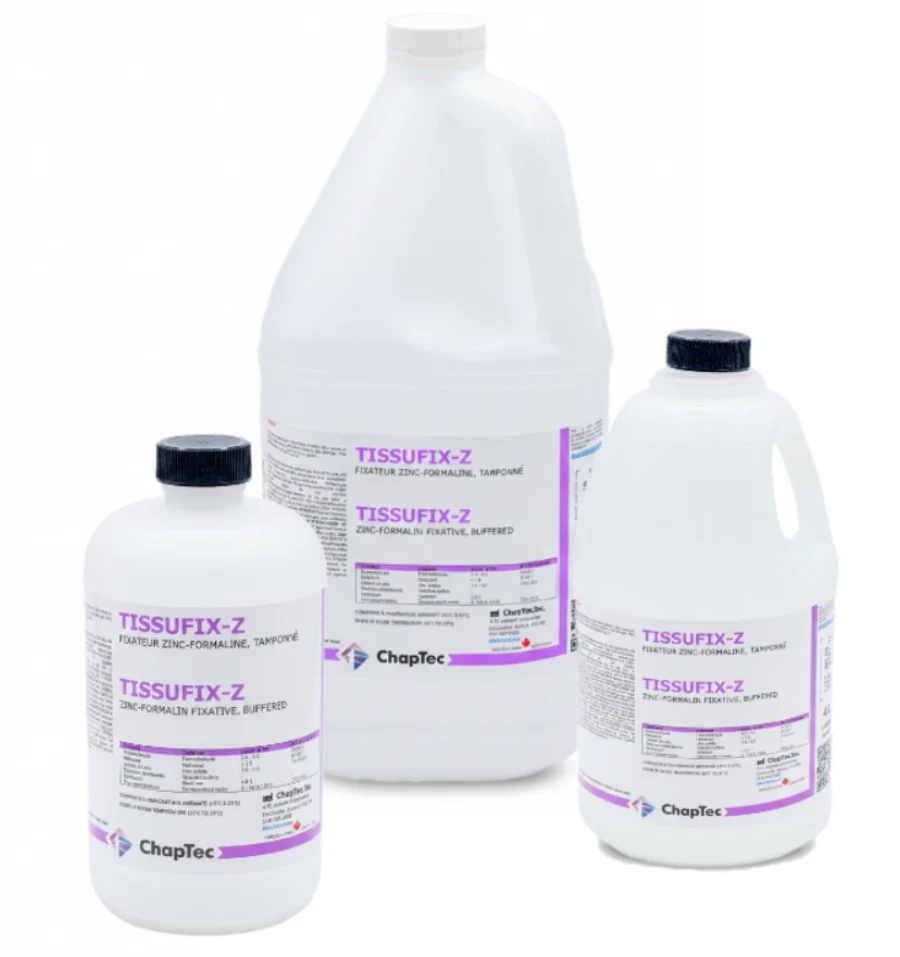
There is now a rapid buffered formalin fixative with added zinc salts. This product (TissuFix-Z) offers the best of both worlds by allowing rapid protein stabilization and controlled cross-linking through zinc salt competition. This allows immunohistochemical staining to work without the need for unmasking methods. Zinc also acts as a mordant, which improves the quality of routine H&E staining.
Are formalin fixation and immunohistochemical staining (IHC) incompatible?
Not entirely, but they can be challenging to combine. While proper tissue fixation is essential for most staining methods, immunohistochemical staining has specific requirements related to antigen preservation.
Why can formalin fixation interfere with immunohistochemistry?
Immunohistochemical staining relies on antibodies that bind to epitopes, which are specific regions of proteins. Formalin fixes tissues by inducing protein cross-linking, and this process can mask epitopes, preventing antibody binding.
Are there ways to restore masked epitopes?
Yes, epitope retrieval methods such as HIER (heat-induced epitope retrieval) are used to unmask epitopes.
Do epitope retrieval methods always work?
No. Their effectiveness is inconsistent—sometimes they work well, sometimes poorly, and sometimes not at all. Additionally, the high temperatures involved can damage or destroy the target proteins.
What role do zinc salts play in tissue fixation?
Zinc salts mixed with formalin compete with formalin and form large insoluble complexes. This reduces excessive protein cross-linking, especially cross-linking that blocks antigenic sites.
Can zinc salts cause problems during fixation?
Yes. If zinc salts act too quickly, proper formalin fixation may not occur, leading to protein denaturation and loss of epitopes required for immunohistochemical staining.
How can this issue be addressed?
The problem can be solved by using a rapid buffered formalin fixative supplemented with zinc salts.
What are the advantages of this type of fixative (e.g., TissuFix-Z)?
It provides rapid protein stabilization while allowing controlled cross-linking through zinc salt competition. This enables effective immunohistochemical staining without the need for epitope retrieval methods.
Does zinc offer additional benefits beyond IHC?
Yes. Zinc acts as a mordant, improving the quality of routine hematoxylin and eosin (H&E) staining.


| 470, avenue Laurendeau, Montréal-Est (Quebec) H1B 5M2 | |||
| Phone: | 514 498-3620 | Toll free: | 833 498-3620 |
| Email: | chaptec@chaptec.com | ||

