

Clear as a bell, as my father used to say.
Today, we're going to talk about clarification, a process that is part of histology tissue processing and typically achieved with a solvent.
In tissue processing, we take a tissue, which contains water and lipids, and make it compatible with the paraffin used for embedding, which is not miscible with either of these components. The tissue is first dehydrated with alcohol, which removes the water. This is followed by a solvent which de-alcoholizes the tissue, as this reagent is compatible with paraffin. This solvent will also dissolve fats and lipids so that paraffin can replace them and provide a structure similar to that of fresh tissue. But the solvent must do something else too: it will modify the tissue's refractive index to make it transparent, as the pathologist will be examining it under the microscope.
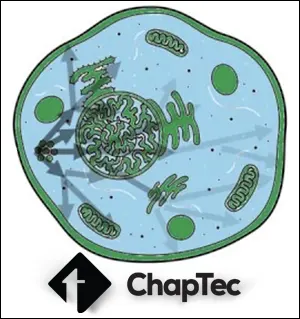
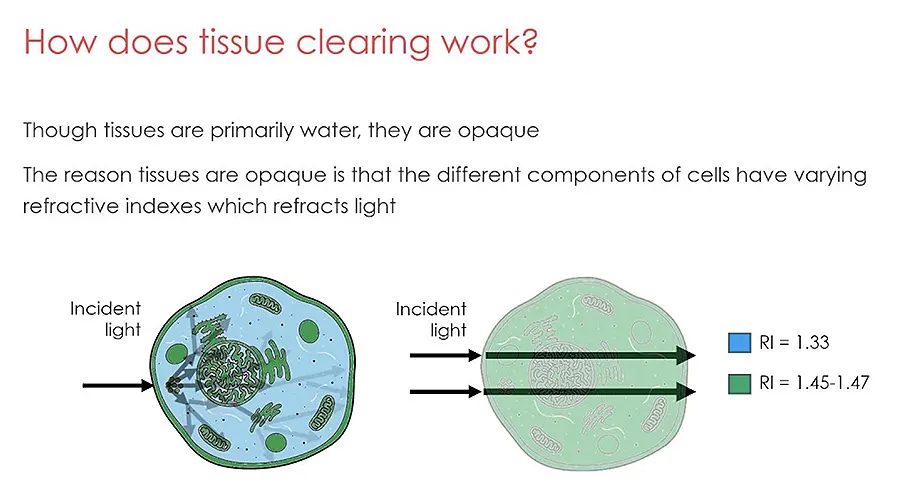
Tissue is made up of several components, all of which have different refractive indices, i.e. they “bend” light differently. Just as a glass microscope slide is transparent, we can still see it because its refractive index is different from that of the surrounding air, which is also transparent. The clarifier must therefore modify the refractive index of these components to make them similar, and close to that of the proteins making up the tissue. In this way, the tissue becomes transparent. If we didn't do this, certain parts of the tissue would be opaque, because the light passing through them would be bent differently from that of the surrounding structures.
The staining that follows will then modify the absorption of incident light by the different structures, enabling them to be visualized and identified under the microscope. I hope this demonstration is…clear!
Q: What is clearing in histology?
A: It is the process of removing alcohol from the tissue using a solvent that is compatible with paraffin.
Q: Why must lipids be dissolved during this step?
A: So that paraffin can replace them and restore structural support similar to that of fresh tissue.
Q: What optical effect must the clearing agent achieve?
A: It must adjust the refractive index of tissue components to make the tissue transparent for microscopic observation.
Q: Why would tissue appear opaque without clearing?
A: Because different structures bend (refract) light differently; clearing makes refractive indices more similar so light passes uniformly.
Q: What will staining accomplish later?
A: It will alter light absorption by different structures, allowing them to be visualized and identified under the microscope


| 470, avenue Laurendeau, Montréal-Est (Quebec) H1B 5M2 | |||
| Phone: | 514 498-3620 | Toll free: | 833 498-3620 |
| Email: | chaptec@chaptec.com | ||

